Rates and thresholds current as at April 2026. MTD ITSA quarterly filing applies to self-employed barristers with gross fee income above £50,000 from 6 April 2026. Subject to change at HMRC’s discretion. Take independent tax advice for your specific circumstances.
If you’ve searched “barrister accountants near me” you almost certainly don’t actually need an accountant who is physically near you. You need one who is near your Bar tax problems: the Class 4 NI change, the basis period reform transition, the £90,000 VAT threshold timed against a fluctuating chambers receipt schedule, the MTD ITSA quarterly filing that lands on 6 April 2026. Below: how a barrister-specialist accountant differs from a general high-street firm or a Big 4 private-client team, an honest comparison table, a worked example for a 4-year junior tenant, and when you actually need a specialist rather than a generalist.
Why “near me” matters less than expertise
The Bar is a tiny client base by accountancy standards. There are fewer than 18,000 self-employed practising barristers in England and Wales (per the Bar Standards Board’s most recent published statistics). A general high-street accountant in London who takes on five barristers a year is still a generalist; a Manchester-based specialist firm with three decades of barrister clients across London, Birmingham, Leeds and Bristol chambers is a specialist. Geography is a secondary consideration after expertise; secure digital portals, video calls and email mean the partner who actually understands your fee-note tax-point timing is not necessarily in your city.
What “near me” really tracks in searcher behaviour is the desire for a specialist who is responsive and reachable, not literally local. Jack Ross has acted for self-employed counsel from a single Manchester office since 1948 and our practice is national. The named clients quoted lower down on this page sit in chambers from Manchester, Salford, the London Bar and the Northern Circuit.
General accountant vs Big 4 vs barrister-specialist: an honest comparison
Three credible options for a self-employed barrister considering an accountant. None is wrong for every barrister; the right choice depends on your practice stage, income complexity, and what you actually need help with. The honest comparison:
| Criterion | General high-street accountant | Big 4 (private client team) | Barrister-specialist (e.g. Jack Ross) |
|---|---|---|---|
| Knowledge of chambers fee-note tax-point treatment (HMRC Notice 700/44) | Often unfamiliar; will research from scratch | Familiar on paper | Routine work every week |
| Familiarity with Mallalieu v Drummond on allowable clothing expenses | Unfamiliar | Familiar | Cited correctly in advice routinely |
| Bar Standards Board rules for VAT registration timing on chambers fees | Generic advice | Specialist advice available | Specialist advice as standard |
| Basis period reform spreading election modelling | Limited | Available; partner-time billed | Standard part of annual cycle |
| Multi-jurisdiction tax (overseas appointments, EU clients) | Limited | Best in class , depth of international tax bench | We refer this work out to a Big 4 colleague when it arises |
| Fee structure | Often hourly, can be unpredictable | High; per-hour partner time premium | Fixed monthly billing |
| Partner access | Variable | Junior staff typically; partner on escalation | Direct partner access by default |
| Best for | Pupils on first six with sub-£50,000 income | KCs with overseas appointments or complex multi-jurisdiction tax | Established self-employed counsel, junior to silk, UK-only practice |
The row that matters most: there is a real situation where the Big 4 are the better choice. KCs with substantial overseas appointment income or EU advisory clients sit in a different tax bracket of complexity, and we routinely refer that work to a Big 4 international tax colleague rather than pretend to a depth we do not have. The honest answer is the right answer.
Worked example: a 4-year junior tenant’s year-end tax bill
The numbers below illustrate the typical year-end tax position for an established junior tenant practising in the 2026/27 tax year. Rates and thresholds are current as at April 2026.
Scenario. A 4-year junior tenant in a Manchester common-law set. Fee income invoiced via chambers, paid on the cash receipts basis. No overseas appointments, no limited-company structure. Single, no dividend or rental income, makes a modest personal pension contribution. Allowable expenses include the standard chambers fees, professional subscriptions, robes, books, and travel between chambers and court.
| Line | Item | £ amount |
|---|---|---|
| 1 | Gross fee income received in the year (cash basis) | £94,800 |
| 2 | Less: chambers fees, clerks’ fees, rent contribution (typical 18%) | (£17,064) |
| 3 | Less: professional subscriptions (Bar Council, Inn, ICCA) | (£820) |
| 4 | Less: robes replacement, professional books, stationery, CPD | (£1,250) |
| 5 | Less: travel chambers to court (mileage at HMRC approved rates) | (£2,400) |
| 6 | Less: home office allowance and proportion of mobile bill | (£860) |
| 7 | Net trading profit (Schedule D) | £72,406 |
| 8 | Less: personal pension contribution (gross-equivalent) | (£10,000) |
| 9 | Net taxable profit before personal allowance | £62,406 |
| 10 | Less: 2026/27 personal allowance | (£12,570) |
| 11 | Profits subject to income tax | £49,836 |
| 12 | Income tax: 20% on first £37,700, 40% on £12,136 | £12,394 |
| 13 | Class 4 NI: 6% on £37,700 above LPL, 2% on profit above £50,270 | £2,706 |
| 14 | Total tax and NI for the year | £15,100 |
| 15 | Payments on account already made (Jan and Jul, prior-year basis) | (£14,200) |
| 16 | Balancing payment due 31 January 2028 | £900 |
Three observations from this worked example. First, the chambers’ rent percentage (line 2) routinely catches generalist accountants out because it varies between common-law and commercial sets and changes mid-year if you move chambers. Second, the personal pension contribution at line 8 is the single largest controllable lever in this tax position: every £1 of pension contribution rescues 40p of higher-rate tax for an income at this level, AND restores £1 of higher-rate-band headroom for next year’s planning. Third, the payments on account at line 15 are calculated on the prior year’s liability; in a year where fees have grown, the January demand undershoots and the balancing payment at line 16 catches up. In a year where fees have fallen, the same payments overshoot and a refund is due. Modelling this from your Q3 numbers, not Q4 wishful thinking, is the difference between a planned tax bill and a January surprise.
When you actually need a barrister-specialist accountant
Use this decision helper to work out where on the spectrum you sit:
- If you are a pupil in your first six: a competent general accountant or a Bar-experienced firm both work. Your tax position is straightforward; the Bar-specific quirks haven’t kicked in yet. Pick on relationship and fee, not depth.
- If you are a junior tenant 1-3 years in: a specialist starts to earn its keep. Chambers fee timing, the £90,000 VAT threshold approach, MTD ITSA onboarding ahead of April 2026 and pension-vs-tax modelling are all live questions a generalist will guess at.
- If you are an established junior or senior junior: a specialist is the obvious choice. Your tax position is now complex enough that the wrong advice on one item costs more than the annual accountant’s fee.
- If you have just taken silk: definitely a specialist. The transition year has overlap-relief decisions, VAT timing, increased pension headroom, and (often) a step-change in fee income that needs to be modelled before April rather than discovered in November.
- If you are a KC with overseas appointments, EU advisory clients, or multi-jurisdiction tax exposure: a Big 4 private-client team is likely a better fit than a UK-Bar specialist. We routinely refer this work out.
- If you are retiring or selling your practice: a specialist who has handled Bar retirements before; the pension-drawdown options, the basis-period overlap-relief unwind, and the final SA return for a year of part-practice all benefit from someone who has done it ten times rather than once.
Specialist barrister accountants by city
Our practice is national. We have city-specific landing pages where local chambers detail is relevant: London, Manchester, Birmingham, Leeds, Bristol, Liverpool, Newcastle and Nottingham. The substantive service is identical: a partner who knows the Bar, fixed fees, secure digital portal, MTD ITSA onboarding.
Why Jack Ross specifically
In our experience of advising self-employed counsel over the past three decades, the single most common reason a barrister switches accountants is not fee , it is responsiveness during the December-January tax-bill window. Three reasons most of our barrister clients give when asked. First, continuity: we have acted for self-employed counsel since 1948, and a substantial proportion of our clients came across as pupils and stayed through silk. The institutional memory of how your tax position evolves matters. Second, direct partner access: you email or call the partner who knows your file, not a triage queue. Third, fixed monthly billing: no clock running on routine queries, no end-of-year fee surprises. The Bar runs on fee notes that are predictable in form and uncertain in timing; your accountant should be the opposite.
What barrister accountants do that high-street firms don’t
The Bar’s tax problems are specific. A general high-street accountant who takes on five barristers a year and several hundred other self-employed clients is solving the average problem. Specialist work on the items below is what differentiates a Bar accountant from a generalist:
- Fee-note tax-point timing under HMRC Notice 700/44 (VAT on counsel’s fees), distinguishing the date of the fee note from the date of receipt for cash-basis VAT
- The chambers VAT vs personal VAT split where chambers’ admin fees are themselves VAT-inclusive and the barrister’s onward billing rests on a different treatment
- Pension-contribution timing against the personal allowance taper between £100,000 and £125,140, where every £1 of pension contribution rescues both 40p of higher-rate tax AND a slice of personal allowance otherwise tapered away
- Robe replacement and clothing-expense treatment per the Mallalieu v Drummond line of cases (everyday wig and gown wear is private; replacement is allowable in defined circumstances)
- The MTD ITSA quarterly cycle from 6 April 2026 against the chambers receipts schedule that does not necessarily line up with HMRC’s quarter ends
- Basis period reform spreading-election decisions where overlap-relief and catch-up profits can be spread across up to seven years, with a higher-rate-band headroom impact that is non-obvious without modelling
- Pre-Bar Council and Inn subscriptions vs Bar Council membership: deductible under the Section 343 ITTOIA 2005 list and the relevant HMRC list of professional subscriptions
Specialist barrister tax knowledge: what we routinely handle
The Bar has its own tax problems. Below is the work we do every week, not a list copied from HMRC’s website.
Payments on account. Your January and July cheques are calculated on the prior year’s liability, not what you actually owe. We model the year-end position from Q3 numbers so the January demand is the figure you have already set aside, not a surprise.
Basis period reform. The 2024/25 transition spread chambers’ overlap relief and any catch-up profits across up to seven years. We have advised on the spreading election where it preserves higher-rate-band headroom and we have also advised against it where the catch-up sits below the personal allowance taper.
MTD ITSA from 6 April 2026. If your gross fee income exceeds £50,000, you will file quarterly digital updates plus a year-end finalisation. We onboard barristers onto Xero or FreeAgent now so the first quarter (to 5 July 2026) is a flick of a switch, not a panic.
Class 4 NI at the new rates. Class 2 was abolished from 6 April 2024; Class 4 dropped to 6% on profits between the lower and upper bands and stays at 2% above. We model both the cashflow effect and the state pension qualifying-year position.
VAT at the £90,000 threshold. The registration threshold has been £90,000 since 1 April 2024. We track your rolling 12-month turnover monthly so registration is a planned step, not a backdated penalty. We also advise on the Flat Rate Scheme limited-cost-trader rules, the chambers-VAT-vs-personal-VAT split, and fee-note tax-point treatment under HMRC Notice 700/44.
Allowable expenses. Robe replacement is allowable under Mallalieu v Drummond; everyday wig and gown wear is not. Travel from home to chambers is private; travel from chambers to court is business. The £1m AIA covers most equipment for a junior practice. Personal allowance taper between £100,000 and £125,140 is recoverable through pension contributions and Gift Aid in the right combinations; we run the numbers each year.
How working with us actually works
Four steps, no surprises:
1. Initial call. Thirty minutes, free, no commitment. We ask about your practice stage, current accountant (if any), and what is bothering you about your tax position. You ask whatever you want.
2. Fixed-fee quote. Within one working day, you get a written quote covering the full annual cycle. The figure is fixed for twelve months and includes everything in the inclusions list below.
3. Onboarding. About two weeks. We request your prior return from your current accountant under standard professional courtesy, set up Xero or FreeAgent, and import your bank feed. You sign a digital engagement letter once.
4. Annual cycle. Quarterly check-ins if you are VAT-registered or under MTD ITSA. Year-end accounts and tax return prepared in the autumn. A one-hour partner-led compliance review every spring covering pension contributions, dividend timing, and any rate changes coming in the next Finance Act. Email queries answered same day in working hours.
What is included in our barrister accounting service
Every fixed-fee engagement covers the work below. Nothing here is an upsell or an add-on; it is the standard package for self-employed counsel:
- Annual statutory accounts and trading summary
- Self-assessment tax return filed by deadline
- Annual compliance review (1-hour partner meeting)
- Quarterly VAT returns (if registered)
- MTD ITSA quarterly submissions from April 2026
- Cloud bookkeeping software (Xero or FreeAgent) included
- Secure document portal for sensitive filings
- Direct partner access by email or phone
- Unlimited email queries, no clock running
- Cash basis vs accruals decision modelling at the £150,000 threshold
Frequently asked questions
Can a barrister form a limited company?
Generally no for chambers work. The Bar Standards Board’s BSB Handbook restricts self-employed practising barristers from delivering chambers work through a limited company. There are limited exceptions for activities outside the scope of regulated legal services (training, lecturing, publishing, mediation in certain configurations). Always check the current BSB Handbook and discuss with chambers before structuring; the rule has been the subject of consultations and may evolve.
Are barristers sole traders or self-employed?
Self-employed sole practitioners, with chambers acting as the administrative vehicle. Each barrister is taxed individually on their own fee income, not as part of chambers. Chambers takes a percentage as administrative fee, which is allowable against profit.
What can an accountant help reduce on my tax bill as a barrister?
Pension contributions (largest single controllable lever, especially in the £100,000-£125,140 taper band), allowable expense capture (chambers fees, professional subscriptions, robes, court travel, home office), VAT timing decisions, the basis period reform spreading election where applicable, and Class 4 NI cashflow modelling. None of these is exotic, all of them need someone who understands the Bar’s specific application.
Do I need a London-based accountant as a barrister?
No. Secure digital portals, video calls and email mean the partner who actually knows fee-note tax-point treatment can be in Manchester, Manchester, or Birmingham. We have London-based chambers clients who have not visited our office; they have visited a partner via video call several times.
What does a barrister accountant typically charge?
Specialist barrister accountants quote on a fixed monthly basis. The right figure depends on practice stage and complexity: pupillage and first-six, established junior, silk, or limited-company structure all sit at different price points. Avoid hourly-billing arrangements for routine work , the work is too predictable in shape and too uncertain in timing for hourly to be fair to either side.
When do I need to register for VAT as a barrister?
When your rolling 12-month turnover of taxable supplies exceeds £90,000 (the threshold since 1 April 2024). For most self-employed counsel, this includes all chambers fees received under cash basis. Once you cross the threshold, registration is required within 30 days. Plan for the registration date, do not be surprised by it.
How does MTD ITSA affect barristers from April 2026?
If your gross fee income exceeds £50,000, you must file quarterly digital updates plus a year-end finalisation through MTD-compatible software (Xero, FreeAgent, QuickBooks). The first quarter ends 5 July 2026 with the update due by 7 August 2026. Onboard onto cloud software now, not in March.
Are clothing expenses (robes, wig, court dress) deductible?
Per the Mallalieu v Drummond line of cases, everyday wear (including wig and gown when used for the dual purpose of warmth or decency) is not deductible. Replacement of specifically protective items is allowable in defined circumstances. The case law is specific; treat it as a settled point rather than a grey area.
Is my chambers fee deductible?
Yes. The chambers fee (typically a percentage of fees billed, plus a clerks’ fee and rent contribution) is allowable as a business expense of your self-employed practice.
Can I claim travel from home to chambers?
No. Home to your normal place of work (chambers) is private travel under the settled HMRC rule. Travel from chambers to court, or court to court, is business travel and deductible at HMRC approved mileage rates.
Can I deduct pension contributions against my fee income?
Yes, subject to the annual allowance (currently £60,000 for 2026/27, with carry-forward of unused allowance from the previous three years), the lifetime allowance (abolished from 6 April 2024), and the taper for high earners. Personal pension contributions made personally (not via chambers) extend your basic-rate band, recovering higher-rate tax on the gross-equivalent amount.
What our clients at the Bar say
We have acted for self-employed counsel since 1948. Many came across as pupils and stayed through silk. Quotes below are from named clients on video; full library at our testimonials page.
“I have been a client of Jack Ross for 30 years now and I came to them when I very first started at the bar, and they’ve literally picked me up and helped me along every single stage of the process.”
– Charles Eastwood, Barrister
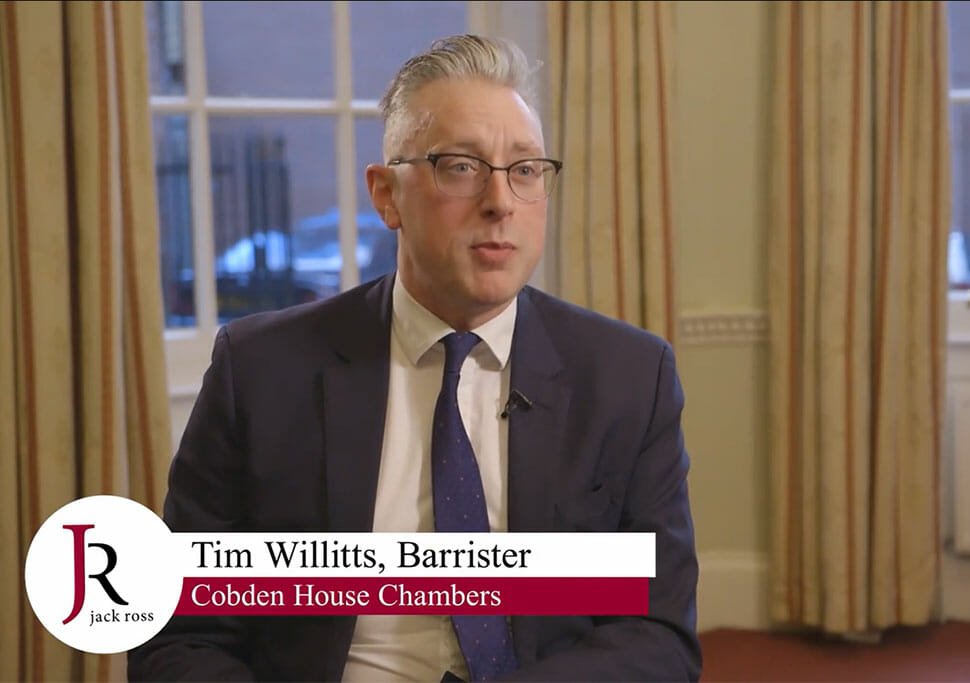
“The specialism that they can point to in the legal sector and in particular for barristers is second to none in my experience.”
– Tim Willits, Barrister
“Jack Ross know the legal system, they work with my Chambers, and I felt they were the best set of accountants for me because they know the legal sector; they know about barristers, and they know what barristers do.”
– Kate Hammond, Barrister
“I would recommend Jack Ross Chartered Accountants as great leaders in the field of providing barrister accounting services.”
– Charles Eastwood, Barrister, St Johns Buildings Chambers
Where else to find help
Authoritative sources for the Bar-specific tax and regulatory questions covered above:
- HMRC VAT Notice 700/44 , Barristers and advocates (canonical reference on fee-note tax-point treatment)
- HMRC: Basis period reform (the 2024/25 transition rules)
- HMRC: Making Tax Digital for Income Tax (MTD ITSA from 6 April 2026)
- Bar Standards Board: BSB Handbook (current rules on practice structure including limited-company restrictions)
- ICAEW: Personal tax technical pages (independent professional reference)
Get in touch
Call 0161 832 4451 or use our contact form. We will reply within one working day with a fixed monthly quote. Pupils in their first six get a discount.
200+ barristers · 75 years · Manchester to London